Vanderbilt University Public Safety quietly launched something this spring that I think deserves a lot more attention than it has received.
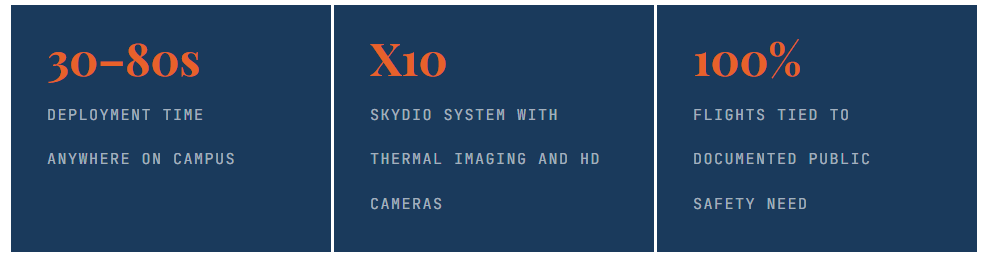
They deployed a drone first-responder program. Advanced Skydio X10 systems that can be anywhere on campus within 30 to 80 seconds. High-resolution cameras. Thermal imaging. Real-time aerial situational awareness delivered directly to first responders before boots hit the ground.
The chief of police at Vanderbilt said it plainly: when you can safely see what is happening before officers arrive, you make faster and more informed decisions. That is not a complicated idea. It is just true. And it is exactly the kind of forward thinking that too few schools and campuses are doing right now.
I want to be clear about what this program is and what it is not. These drones are not surveillance tools. They are not watching students go to class or monitoring daily campus activity. They are dispatched to specific calls for service and emergency situations. Every flight is tied to a public safety need. There is oversight. There is documentation. Vanderbilt built it with transparency as a foundation, not an afterthought.
That matters. Because one of the reasons new safety technology gets rejected in schools is that communities do not trust it. Vanderbilt addressed that directly. They published detailed FAQ documents. They trained their officers to FAA certification. They made clear that this technology exists to protect their community, not to watch them.
I think about Covenant. I think about Uvalde. I think about every situation where the difference between lives saved and lives lost came down to how quickly responders understood what was happening inside a building or across a campus. Real-time aerial intelligence does not replace trained officers. It makes them more effective. It gives them information they would not otherwise have until it was potentially too late.
Vanderbilt is a university, not a K-12 school district. But the principle applies everywhere. The technology is available. The question is whether school leaders are willing to invest in it, implement it responsibly, and communicate openly with their communities about how it works and why.
This is what proactive safety looks like. Not waiting for something to happen and then forming a task force. Building the capability before you need it.
Read the full Vanderbilt announcement : news.vanderbilt.edu
See what technology your school actually has in place.
The School Safety Dashboard is free, built so you do not have too wonder.
Technology will not solve the school safety crisis alone. But refusing to use the tools available to us is not an answer either.
For Alex. And for all of them.
Max Schachter