Police in Bend, Oregon, arrived at Silver Rail Elementary 3 minutes after the first 911 call.
That is about as fast as a police response gets anywhere in this country.
It was not fast enough. By then, 3 children and a teacher had been killed.
On Thursday, October 15, a 16-year-old former student climbed the school fence, walked to an outside set of double doors and found them locked. So he fired into the glass, stepped through, and walked into the first classroom inside the entrance. It was a special needs classroom.
Rhoam Summer was 5. Megan Lambert was 25, a teacher her family says was working her dream job and "always fought for the underdog." 2 boys, ages 8 and 11, were also killed. Their families have asked that their names stay private. A 7-year-old girl and teacher Becky Drury were wounded.
It could have been worse. A teacher threw her phone at the gunman and tackled him. A father with 2 daughters at the school followed him inside and stopped him. His family says he does not want recognition, so I will not name him here. They have my gratitude.
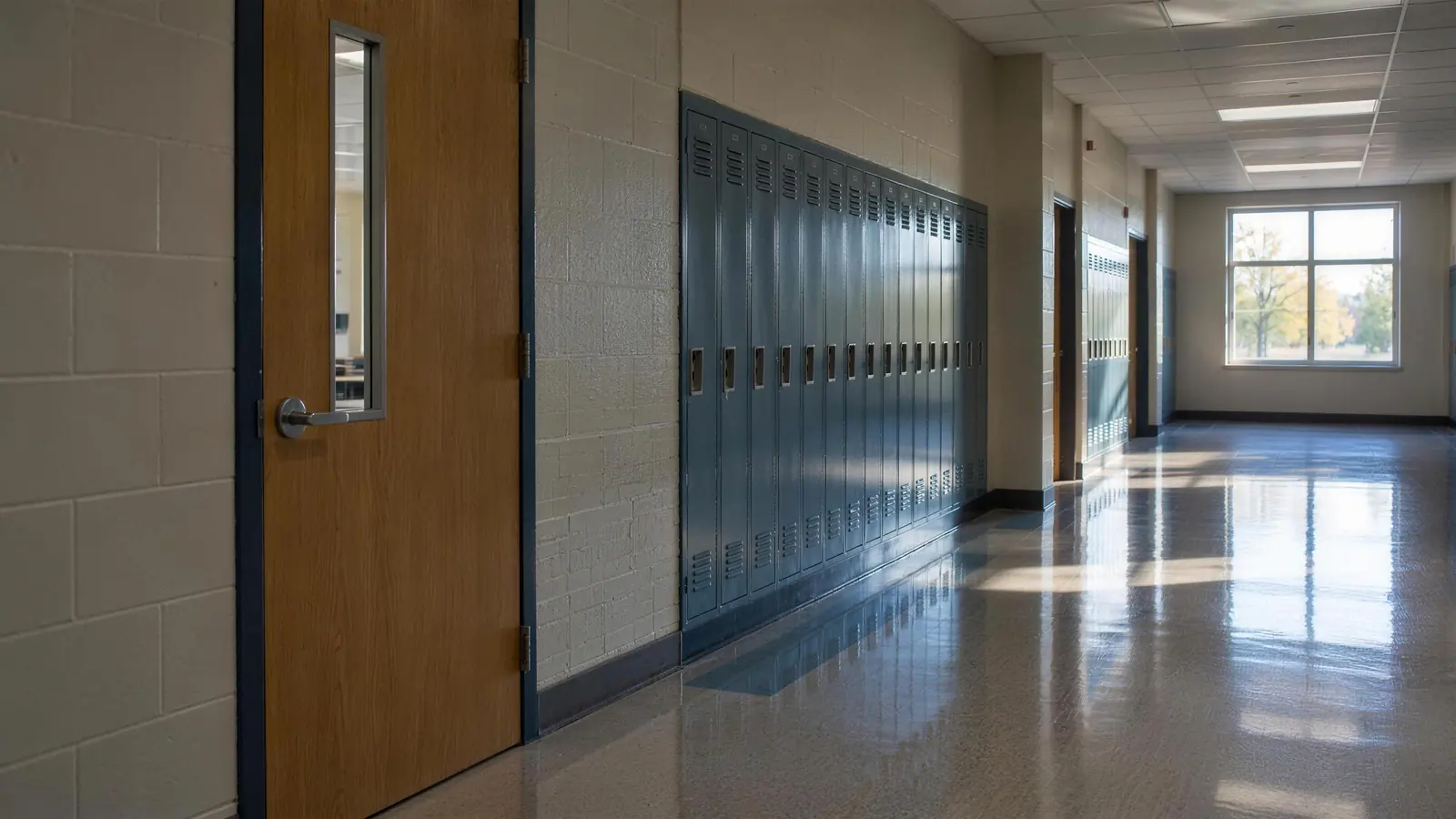
In the days ahead, most of the conversation will be about the shooter, the gun and the heroes. I want to talk about the glass. Because the door was locked, and it still was not enough.
Same weak point, different schools
I have spent 8 years studying how these attacks unfold. Glass keeps showing up.
4 schools, 1 weak point
How attackers got past a locked or closed door.
Sources: Connecticut State's Attorney (2013); MSD Public Safety Commission report (2019), p. 24; Metro Nashville Police; Bend Police Department
Parkland is personal. The commission that investigated the shooting found that the gunman "never entered a single classroom" in Building 12, where my son Alex was killed. Every shot into a classroom was fired through the door or the window in the door.
The commission also found something that has stayed with me. A hard corner is the part of a classroom you cannot see or reach from the door window. "If you went into that classroom and you took a hard left into a hard corner, you were going to be safe," the commission's chair, Pinellas County Sheriff Bob Gualtieri, said. Only 2 of the school's 30 classrooms had a marked hard corner.
What the new research shows
This spring, the ALERRT Center at Texas State University, which trains police across the country to respond to active shooters, published the most detailed study I have seen on doors in school shootings. It looked at 54 school attacks from 2000 to 2025 and tracked every door the attackers touched.
Most of the time, attackers got in because the door was not locked. That is the first lesson, and it is the easiest one to fix. But when a door was locked and an attacker still got through, it was the glass that gave way.
How attackers got through the door
29 doors that attackers entered in 54 school shootings, 2000 to 2025.
Source: ALERRT Center, Texas State University, with the Security Industry Association, The Role of Locked Doors and Access Control in School-Based Active Shooter Events (2026)
Attackers tried to force their way through a locked door 9 times. They succeeded 6 times. Every one of those 6 went through glass. The study found no case where an attacker got through a solid door with a working lock.
The researchers put it in 7 words: "Glass is the primary point of mechanical failure."
And locking still matters enormously. Behind locked or barricaded doors, someone was hurt about 1 time in 6. Behind unlocked doors, it was 1 time in 2.
Did anyone get hurt behind the door?
Share of doors in the study where at least 1 person behind it was shot.
Source: ALERRT Center and Security Industry Association (2026). Small sample; the researchers note it should be read with caution.
One more finding matters for parents of young children. In every elementary school attack in the study, the attacker came from outside the building. At an elementary school, the outside doors and the glass in them are the front line.
Every layer has a job
School security works in layers. Each one is meant to slow an attacker down and buy the seconds that let teachers lock down and police arrive. Here is how those layers lined up in Bend.
The layers between an attacker and a classroom
What each layer is for, and what happened at Silver Rail Elementary.
- 01Perimeter fenceSlows and channels anyone approaching. In Bend: he threw the gun over and climbed.
- 02Exterior doors and glassKeeps an attacker outside. In Bend: the doors were locked. He fired through the glass panes.
- 03Distance to classroomsGives teachers time to lock down. In Bend: the classroom was just inside the entrance.
- 04Classroom doorA locked solid door has never been breached in the study's 25 years of data. Its glass panel is the weak spot.
- 05Hard cornerThe last layer. A marked spot out of view of the door window.
Sources: Bend Police Department timeline; ALERRT Center and SIA (2026); MSD Public Safety Commission (2019)
I want to be fair to Bend-La Pine Schools. This is a district that invested in security. By 2024, local reporting showed every school had a secure vestibule entrance, and the district was replacing locks on about 3,200 doorways. We do not yet know which doors he came through or what kind of glass was in them. Investigators will tell us.
What we do know is that a locked door bought very little time. And when the first classroom sits right inside the entrance, there is very little time to lose.
What glass can't do
Glass upgrades are not a cure. Most security film delays an attacker. It does not stop bullets, and any product sold as "bulletproof film" should make you suspicious. A strong pane in a weak frame still fails. And no glass helps when the attacker is already a student inside the building, which was true for 2 out of every 3 attackers in the study.
That is why prevention still comes first: threat assessment, anonymous reporting, and adults who notice. Glass is one layer. It happens to be the layer that keeps failing.
What actually works
Walk the building and count the glass. List every exterior door with glass in or beside it, and every classroom door with a window. Start with the main entrance and any outside door that opens near a classroom. That is where Bend happened.
Upgrade with tested systems. There is now a standard built for exactly this. ASTM F3561 tests the whole assembly, the glass, the frame and the hardware, after simulated gunfire, then measures how well it resists someone trying to force through. Ask any vendor for independent test results on the full system, not just the film.
Lock every classroom door, every time. Doors that lock from the inside, without stepping into the hallway, are the single best tool we have. The 2027 International Building Code will require them in schools.
Cover the door window and mark the hard corner. The Parkland commission told every Florida district to give teachers a quick way to cover door windows and to mark a hard corner in every classroom. It costs almost nothing. Every school in America can do it this month.
If you are a parent, ask your principal 2 questions: "Which outside doors at my child's school have glass, and has that glass been assessed?" and "Does my child's classroom have a door that locks from the inside and a marked hard corner?" If you are a teacher, stand outside your classroom door tonight and look in through the window. Every spot you can see is a spot an attacker can see. Find the part of the room you cannot see, clear it, and make sure every student knows to go there.
See the safety picture for your district. Our School Safety Dashboard shows the safety incidents your district officially reported, how they have changed over time, and how your district compares with the state average.
- Open the dashboard and search for your school or district.
- Go to Safety Incidents. You'll see every incident type the district reported, from threats to weapons.
- Click any incident type to see this year's count, the change from last year, and the trend against the state average.
For Alex. And for all of them.
Max Schachter
If someone needs help
If a child or adult is struggling after this news: call or text 988, the Suicide and Crisis Lifeline.
Talking with kids about school shootings: National Association of School Psychologists guide
Anonymous tips for students and adults: Sandy Hook Promise Say Something, 1-844-572-9669
Immediate danger: call 911.
Data: ALERRT Center at Texas State University, the Security Industry Association, the MSD Public Safety Commission and the Bend Police Department. Learn more at schoolsafetydashboard.org.