I have read more of these timelines than any father should. After my son Alex was murdered at Marjory Stoneman Douglas, I read the one that led to his killing. It was not a mystery. It was a long trail of warning signs that people saw and did not act on. So when the ADL published 2 new timelines, tracing the online lives of 2 teenagers before they became school shooters, I did not see 2 random tragedies. I saw the same map, drawn again.
The first attack was in December 2024, at a small Christian school in Madison, Wisconsin. A 15 year old opened fire during a study hall, killing a teacher and a 14 year old student before taking her own life. 6 others were wounded.
About 5 weeks later, in January 2025, a 17 year old walked into the cafeteria of a high school in Nashville, Tennessee, and killed a 16 year old girl before taking his own life.
The people we should remember are Erin West, Rubi Vergara, and Josselin Corea Escalante. A teacher and 2 girls. I am not going to name the 2 who killed them, because notoriety is part of what they were chasing. But I do want to talk about how they got there, because the ADL just showed us, step by step.
The ADL's Center on Extremism went back through the online footprints both teenagers left behind. What they found was not a sudden break with reality. It was a slow, documented descent. Both had spent enormous amounts of time in the same corners of the internet: violent gore sites, extremist forums, and communities that treat cruelty as entertainment and mass killers as celebrities.
One of those sites, which ADL named directly, is a "gore" website built around real footage of people dying. For a lonely, struggling kid, it can be a doorway. From there the path runs toward extremist ideology, toward networks like 764 that deliberately target and manipulate minors, toward a worldview where violence is the entire point. Investigators found the 2 shooters' accounts were connected across several platforms, and believe they may have moved through the same digital spaces.
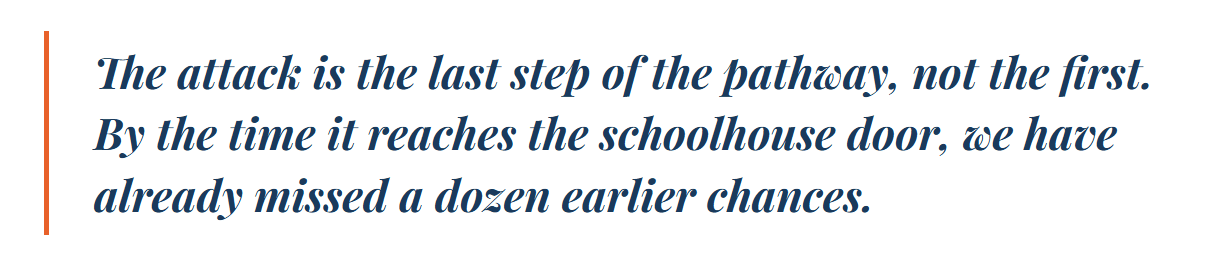
Here is what matters about that. The violence did not begin the morning they walked into those schools. It had been building for months, maybe years, online, in plain sight, on devices sitting in bedrooms and backpacks. ADL called their activity what it was: a series of missed opportunities to step in.
Smart starts here.

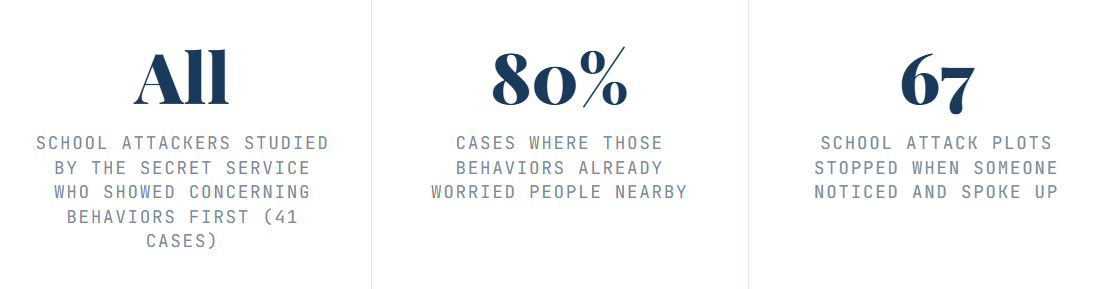
If that sounds like an overstatement, look at the research. The U.S. Secret Service's National Threat Assessment Center studied 41 targeted school attacks over a decade. Their finding was unambiguous. Every single attacker had shown concerning behaviors beforehand. In 80% of the cases, those behaviors were alarming enough that people around them noticed. 2 out of 3 attackers had told someone, in some form, what they were planning.
The Center's chief said it as plainly as it can be said. These are not sudden, impulsive acts. The majority of these incidents are preventable. I want that sentence framed in every school board room in America. Violence against a school is a process. And a process, unlike a lightning strike, can be interrupted.

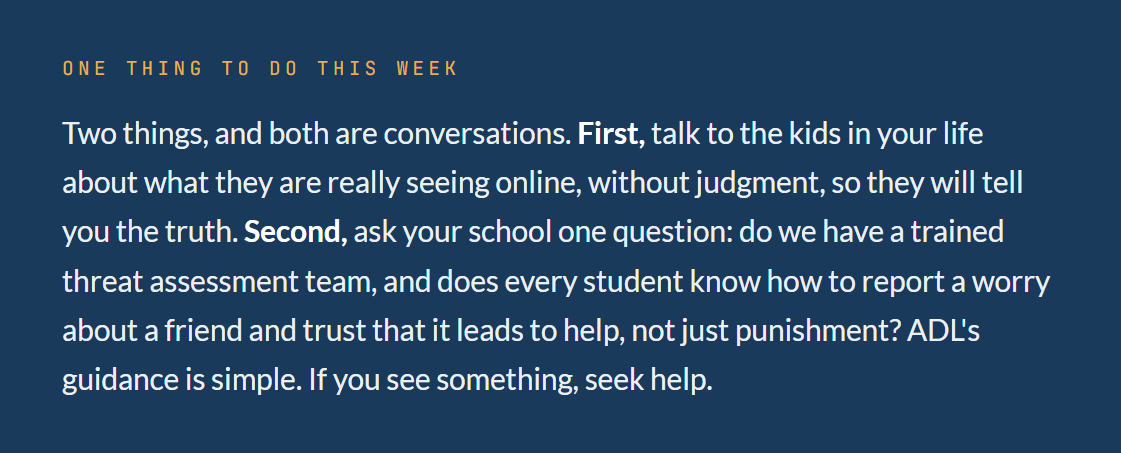
The same researchers studied something more hopeful, too: 67 school attack plots that never happened. Almost every one was stopped the same way. A bystander, usually another student, saw something that worried them and told an adult who could act. That is the entire ballgame. Not metal detectors. Not turning schools into fortresses. A kid who says something, and a system that actually does something with it.
So proactive is not a mystery here either. It looks like a trained behavioral threat assessment team in every school, whose job is not to punish a struggling kid but to get around them and get them help. It looks like community programs that can pull a teenager back off an extremist spiral, the kind of off ramps that ADL rightly points out are underfunded and unevenly available across the country. It looks like parents who know what a gore site and a grooming network actually look like, so the pipeline is not invisible to the adults in the house. And it looks like holding the platforms accountable for the algorithms that feed this content to children in the first place.

Prevention starts with seeing the whole picture. Track school safety where you live.
Two timelines. Two maps to the same terrible place. The hardest part is not that we could not see these coming. It is that, if we are honest, we could.
For Alex. And for all of them.
Max Schachter
Sources & Notes
Timelines and analysis: ADL Center on Extremism, "Pathways to Youth Violence: Understanding the Threat Landscape." Prevention research: U.S. Secret Service National Threat Assessment Center, "Protecting America's Schools" (2019) and "Averting Targeted School Violence" (2021). Incident details: Madison Police Department and Metropolitan Nashville Police Department.
This piece touches on youth violence and suicide. If you or someone you know is struggling, the 988 Suicide and Crisis Lifeline is available 24/7 by call or text. Learn more about school safety at schoolsafetydashboard.org.