On May 11, a man opened fire on Memorial Drive in Cambridge, Massachusetts. He fired at least 60 rounds from an assault-style rifle into cars and at people walking by. Two people are hospitalized with life-threatening injuries. The shooter, Tyler Brown, was ultimately stopped by a state trooper and a former Marine who happened to be driving by with a legally owned firearm.
This is a gun violence story. But I want to talk about it as a threat assessment story. Because almost everything that needed to be known about Tyler Brown was already known. And the system still could not stop what happened.
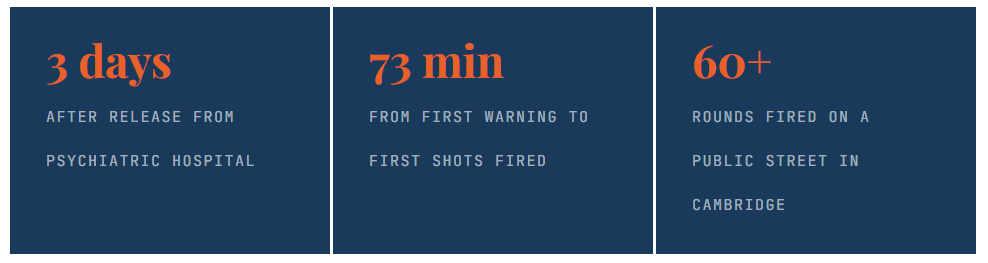
Brown had been released from a psychiatric hospital three days before the shooting. He had previously served time in prison for shooting at Boston police officers in 2020 while already on probation for a 2014 conviction. He was on parole. He had a parole officer. Less than two hours before the shooting, that parole officer was told Brown had relapsed on crack cocaine and was ready to end his life.
The parole officer reached Brown on a video call at 12:08 in the afternoon and saw him waving a semi-automatic rifle inside a kitchen. Brown said he was not going back to prison. He claimed to have committed murders that he had not been caught for. He ended the call. Less than an hour before the shooting, he called back and told the parole officer that people were going to pay.
Police obtained two search warrants. Boston police called Cambridge police at 1:06 in the afternoon. The first shots were reported at 1:30.
Seventy-three minutes passed between the moment police knew Tyler Brown was in Cambridge with a rifle and the moment he started shooting. I am not here to second-guess every decision made in those 73 minutes. Law enforcement was working under extreme pressure with incomplete location information. They moved as fast as the system allowed them to move.
But that is exactly the point. The system determined how fast they could move. And the system was not fast enough.
This story is not primarily about schools. But the lesson is one I talk about in school safety contexts every single day. Threat assessment only works when every part of the system is connected and fast. You need the information. You need the communication. You need the authority to act. And you need the speed to act before the window closes.
Brown's parole officer did the right things. He flagged the risk. He made the calls. He started driving to Brown's residence. The warrant process worked as designed. What the system could not do was compress the timeline enough to get law enforcement in front of Tyler Brown before he got onto Memorial Drive.
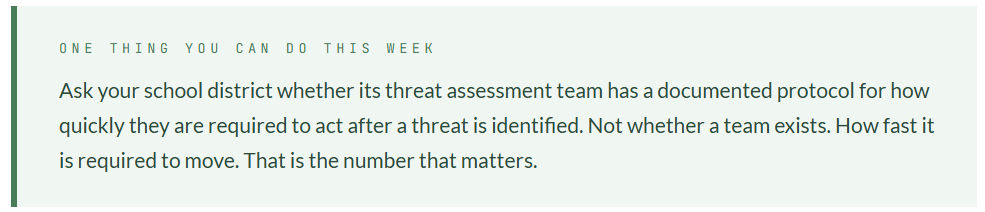
In our schools, we talk about this as the difference between identification and intervention. You can identify a threat perfectly and still fail if the intervention is too slow. The same principle applies everywhere. Threat assessment is not just about gathering information. It is about having a system that can act on that information in time.
The former Marine who helped stop Brown that day was not part of any system. He was driving south on Memorial Drive, saw an officer being shot at, and used a legally owned firearm to end the threat. I am grateful he was there. I am also troubled by how much depended on him being there.
We can do better. We have to do better. Not just for school campuses. For every community in this country.
Read the full WBUR investigation: wbur.org
DOES YOUR SCHOOL HAVE A THREAT ASSESTMENT TEAM IN PLACE RIGHT NOW?
Check your school’s safety data free at http://schoolsafetydashboard.org/, built so every parent has the information they deserve.
The warning signs were there. They almost always are. The question is always whether the system is built to act on them in time.
For Alex. And for all of them.
Max Schachter