Think about what happens after a hurricane. Before the storm even makes landfall, FEMA is staging supplies. Afterward, federal teams arrive to help families find shelter, file claims, rebuild, and recover. The same is true after an earthquake, a flood, a wildfire. We have built, over decades, a coordinated federal response to disaster. It is not perfect. But it exists, and it shows up.
Now think about what happens after a school shooting.
The FBI does good and important work. Local law enforcement responds. But there is no coordinated, whole of government plan for how federal agencies come together to support the families and the community in the days, weeks, and years that follow. There is no FEMA for this. After the worst day of a community's life, families are largely left to navigate the aftermath on their own.
I know this because I have lived it. And I recently sat down with my friend Benjamin Bawden, a school safety expert who works with law enforcement organizations across the country, to talk about a bill that would begin to change it.

When a natural disaster strikes, the federal government has a playbook. Agencies know their roles. Resources are pre-positioned. There is a chain of command and a recovery process that, for all its flaws, has been refined over many years and many storms.
After a targeted act of violence at a school, none of that coordinated structure exists in the same way. Different agencies have different pieces. Information does not always flow. Families who have just suffered the unimaginable are often left to figure out, on their own, who to call and what help is even available. The country treats one kind of mass-casualty event as a coordinated national priority and the other as a local tragedy to be absorbed quietly.
That difference is not because school violence is rare. The opposite is true. By the federal government's own account, the current school year has already seen a record number of school shootings. This is not a fading problem. It is a growing one. And our national response has not kept pace with it.

The bill is called the National Strategy for School Security Act. It is refreshingly straightforward, and that is part of why I support it. It does not promise the world. It does one foundational thing that, somehow, has never been done.
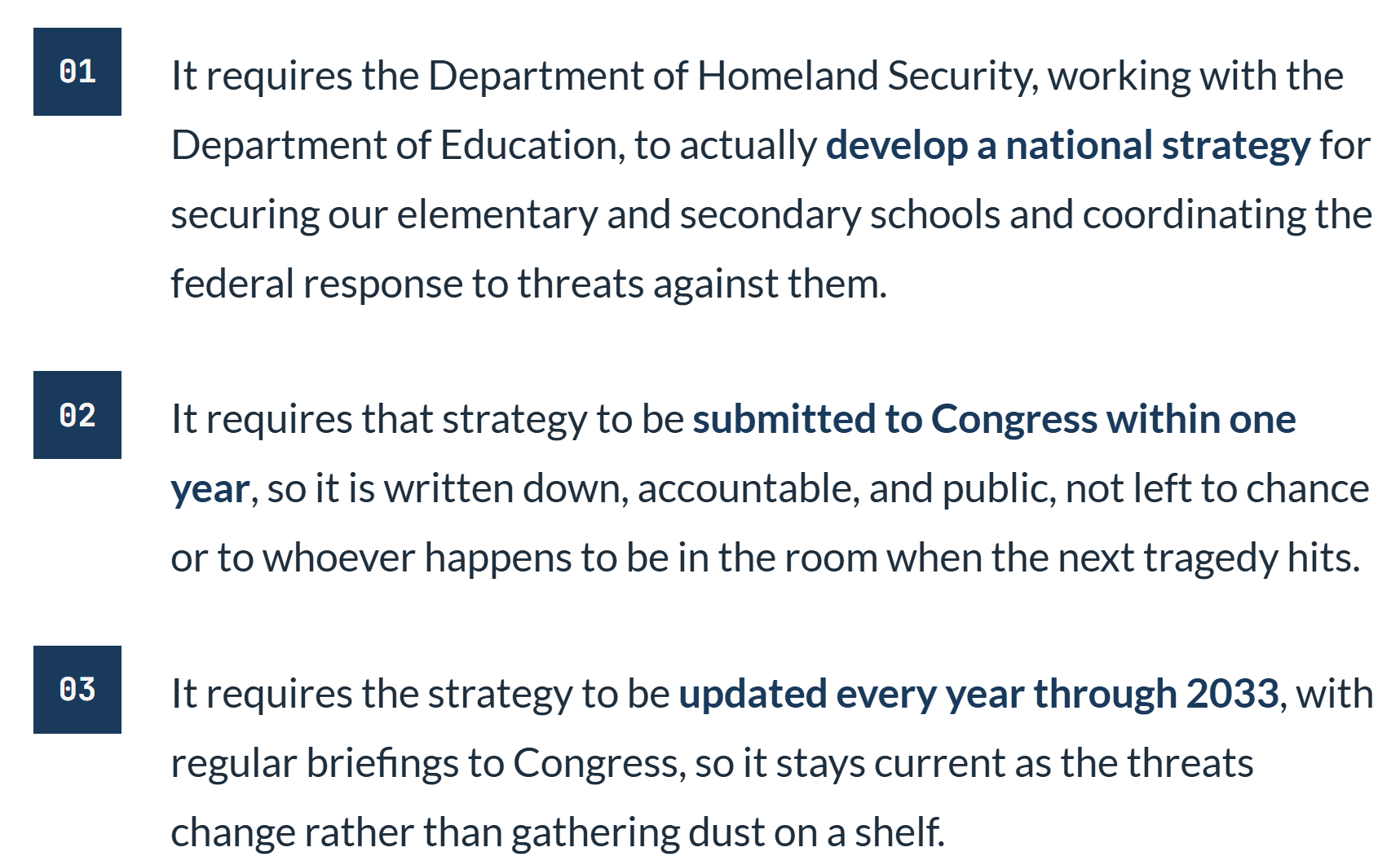
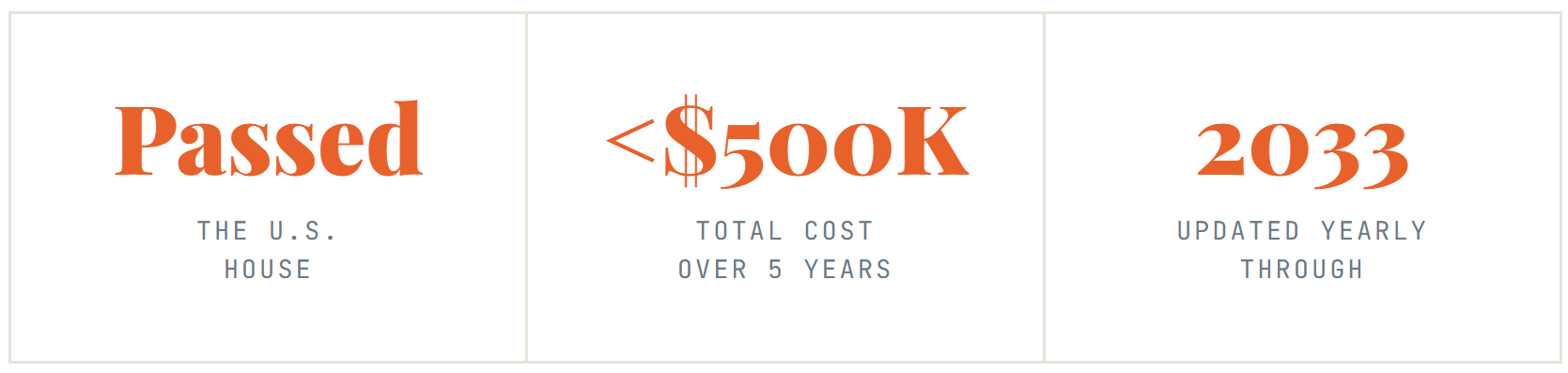
That is it. It does not cost much. The Congressional Budget Office estimated the whole thing at under $500,000 over five years, which in federal terms is essentially a rounding error. What it creates is something we have never had: a single, coordinated, accountable federal plan for keeping schools safe and for responding when prevention fails.
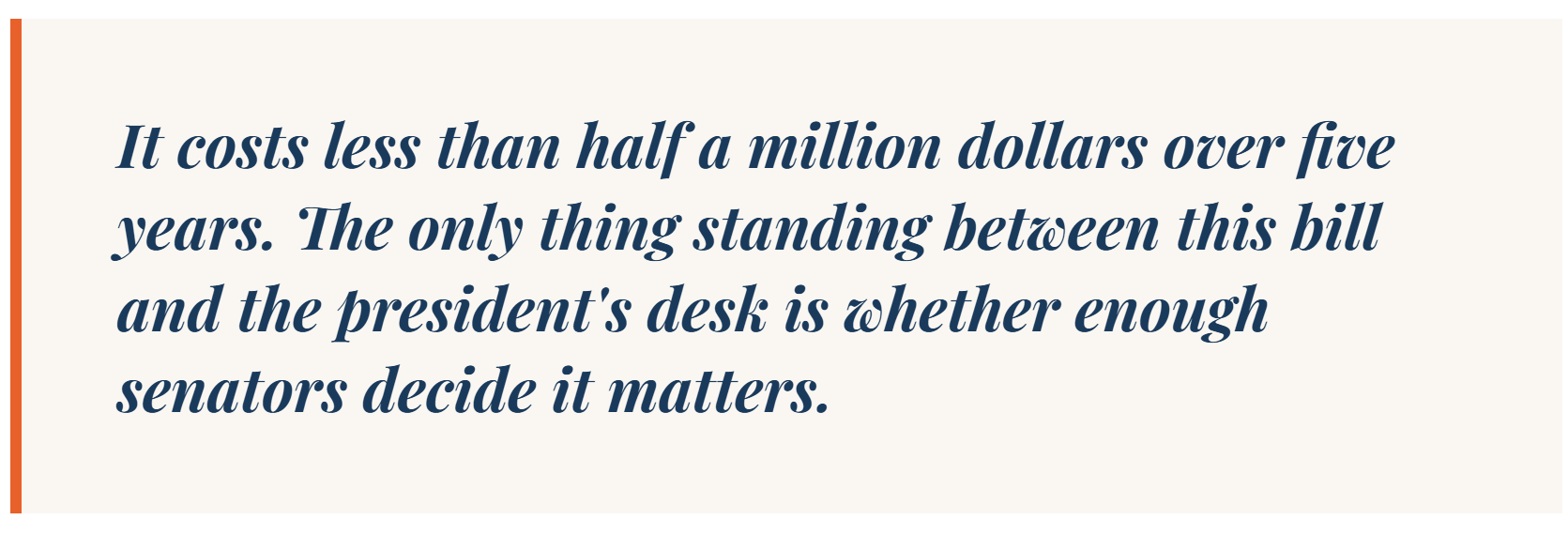

Here is the good news, and the reason I am writing to you about it today. This bill is genuinely close.
The House version, led by Congressman Tony Gonzales of Texas, already passed the House. On the Senate side, Senator Shelley Moore Capito of West Virginia introduced the companion bill alongside Senator Maggie Hassan of New Hampshire, and it has been referred to committee. This is a bipartisan effort. It has moved further than most school safety bills ever do.
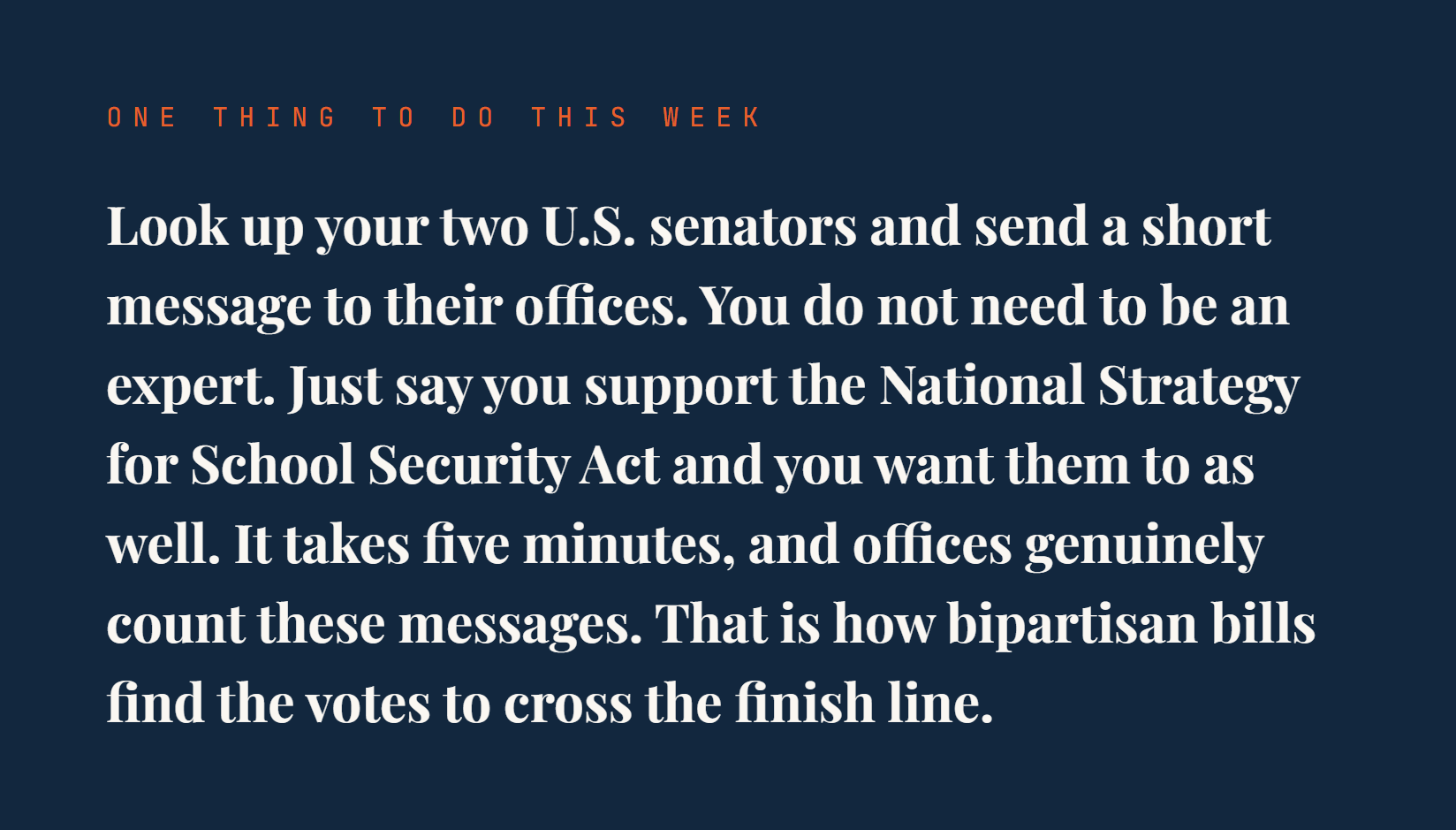
What it needs now is momentum in the Senate. More senators signing on. More constituents letting their offices know this matters to them. That is exactly the kind of pressure that moves a bill from "referred to committee" to "passed" to "signed into law."
I want to be clear about what this bill is and is not. It is not a magic fix. It will not, by itself, stop the next tragedy. A strategy on paper is only as good as the action it drives. But you cannot coordinate a response you have never planned. You cannot improve what you have never measured. Every serious effort to protect children has to start with a real plan, and right now, at the national level, we do not have one.
This is how the work actually gets done. Not in one dramatic moment, but in unglamorous, foundational steps like this one. A strategy. A requirement to keep it current. A commitment, written into law, that the federal government will treat the safety of children in schools as the national priority it should have been all along.
We do this for hurricanes. We do it for earthquakes. It is long past time we did it for our kids.
SEE HOW YOUR SCHOOL MEASURES UP
We have proven, again and again, that this country can organize itself to protect people from disaster. Our children deserve to be on that list. Let's get them there..
For Alex. And for all of them.
Max Schachter